
PHASE ONE
Renewable Power Island and Data Center Campus
Dedicated power and long-term sites for AI and advanced computing.
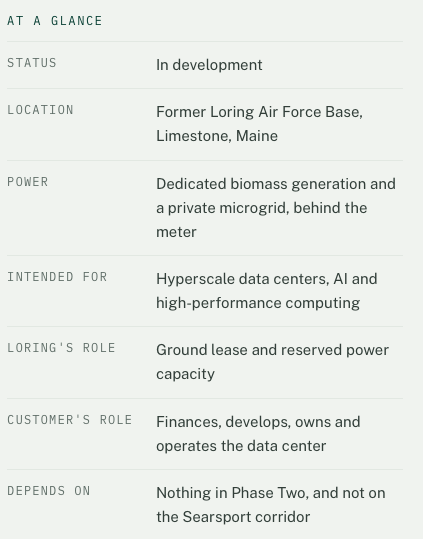
Phase One is a proposed energy and data-center development at Loring in Northern Maine. It is planned around dedicated biomass-based renewable generation and a private microgrid, with the objective of supplying dependable power around the clock.
The campus is intended for hyperscale data centers, artificial-intelligence computing, high-performance computing, and other commercial users with substantial long-term energy requirements.
DEFINITION
What is a Renewable Power Island
A Renewable Power Island is a dedicated energy system designed to serve an industrial customer through generation located behind the site's meter. Phase One planning centers on biomass-based generation and a private microgrid intended to operate independently of the public electricity supply.
Dependable service requires the complete system to be designed around the customer's load, including fuel supply, maintenance, redundancy, backup arrangements, and operating requirements. Those details will be established through engineering and commercial development.
LOCATION
Why Northern Maine
Industrial Setting
The former Loring Air Force Base provides an established setting for evaluating large industrial development.
Regional biomass resources
Northern Maine's forest-products economy offers a foundation for evaluating long-term biomass supply, transportation, and procurement.
Climate
The region's cold climate offers opportunities to reduce cooling demand, with performance dependent on the final data-center design.
Development experience
Loring Holdings brings years of work on property interests, energy infrastructure, engineering, and commercial planning.
STRUCTURE
How the business works
Loring Holdings' role is to provide a long-term power-and-site platform, including ground leases and reserved power capacity under negotiated commercial agreements.
The data-center customer finances, develops, owns, and operates its facility. The site, energy requirements, delivery schedule, and expansion plan would be established with each customer.
LORING HOLDINGS
Power and site platform
Dedicated biomass generation
Private microgrid
Long-term ground lease
Reserved power capacity
→
←
DATA CENTER CUSTOMER
Data center campus
Finances the facility
Develops and builds
Owns DC assets
Operates the campus
Negotiated commercial agreements define the boundary
Proposed ownership split. Terms are established with each customer.
LIMESTONE, MAINE
Phase One and the community
Limestone residents should be able to understand how a proposed industrial project would affect local power, employment, roads, water, and public services. These are practical questions that deserve project-specific answers.
Maine's industrial history offers a useful starting point: on-site energy systems and a local supply chain can connect a major facility to the surrounding economy. The proposed campus would need to demonstrate those connections through its own design, operations, and community arrangements.
-
The proposed operating model uses dedicated on-site generation to supply the campus. Final engineering must establish how the system would operate during normal service, maintenance, and emergencies, including any utility connections or backup arrangements.
-
Potential employment includes construction trades, power-plant and data-center operations, maintenance, and biomass harvesting and transportation. Construction jobs, permanent campus jobs, and regional supply-chain jobs are different categories and will be reported separately as estimates are refined.
-
Potential benefits include municipal revenue, negotiated community support, local purchasing, and employment. The scale and timing depend on the facilities actually developed, their assessed value, commercial arrangements, and any agreements reached with the town.
-
Fuel planning must address sourcing practices, available volumes, competing uses, transportation routes, and long-term supply reliability. Regional forestry and hauling activity is an important part of evaluating both the economic opportunity and local impacts.
-
These impacts require engineering studies and environmental review. Cooling design, water requirements, emissions controls, operating noise, and truck movements need to be assessed for the proposed facilities and their location.
-
Use the Community Question option on our Contact page to ask about Phase One or its potential local effects.